Produced Water in the Permian Basin
Jul 2024
University of Texas, Bureau of Economic Geology · 2022–2024
The problem
Unconventional oil wells in the Permian Basin produce large volumes of water alongside oil, and that water has to be managed or disposed of. Understanding where production and water volumes are concentrated is central to managing it.
Approach
- Cleaned and joined well-level production data from S&P Global (IHS) Enerdeq in R, automating repetitive processing steps.
- Aggregated results onto square-mile blocks in ArcMap, so basin-wide patterns stay readable at the scale of the Delaware and Midland basins.
Results
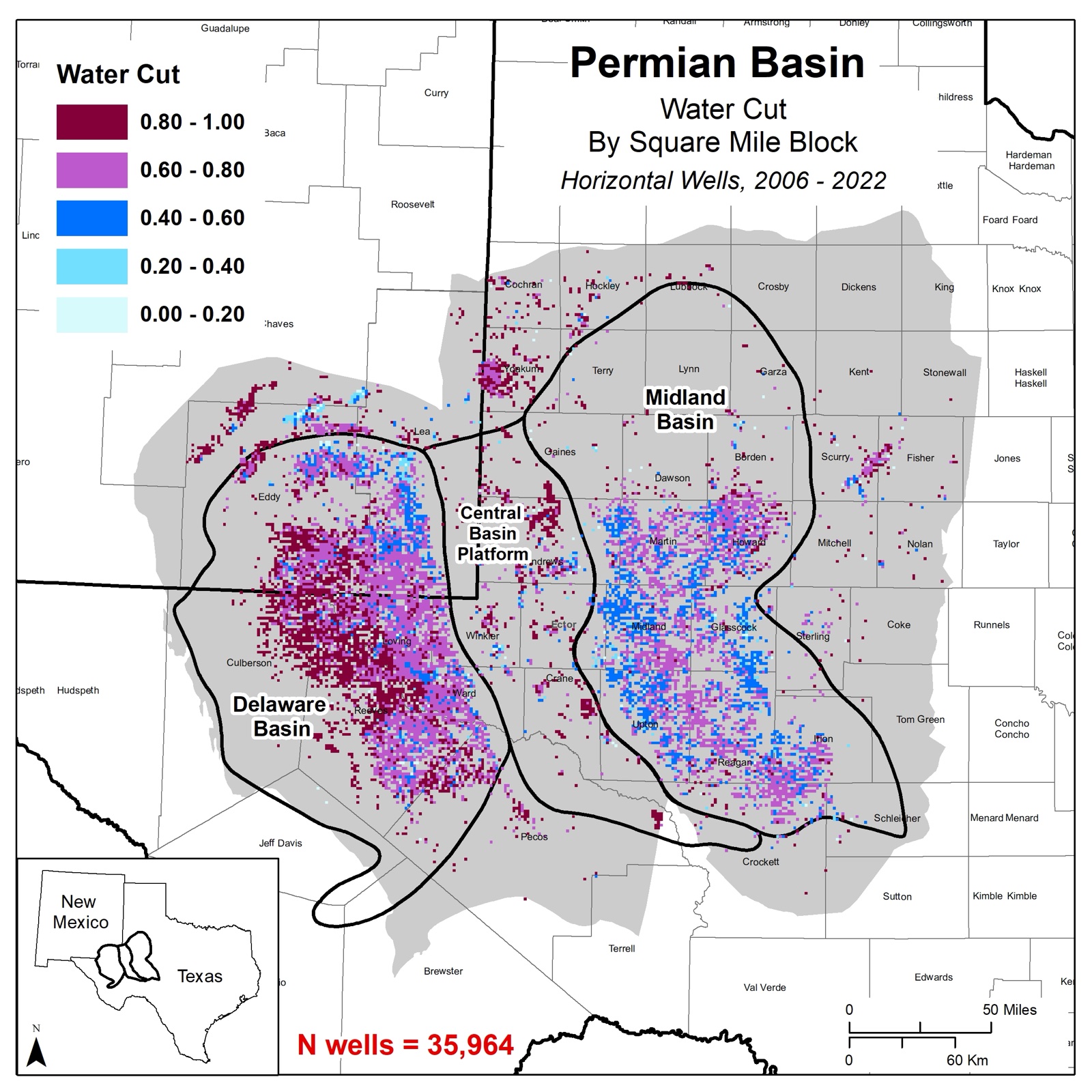
Water cut (produced water ÷ (produced oil + produced water)) for 35,964 horizontal wells completed 2006–2022, by square-mile block. Water cut runs highest across the Delaware Basin.
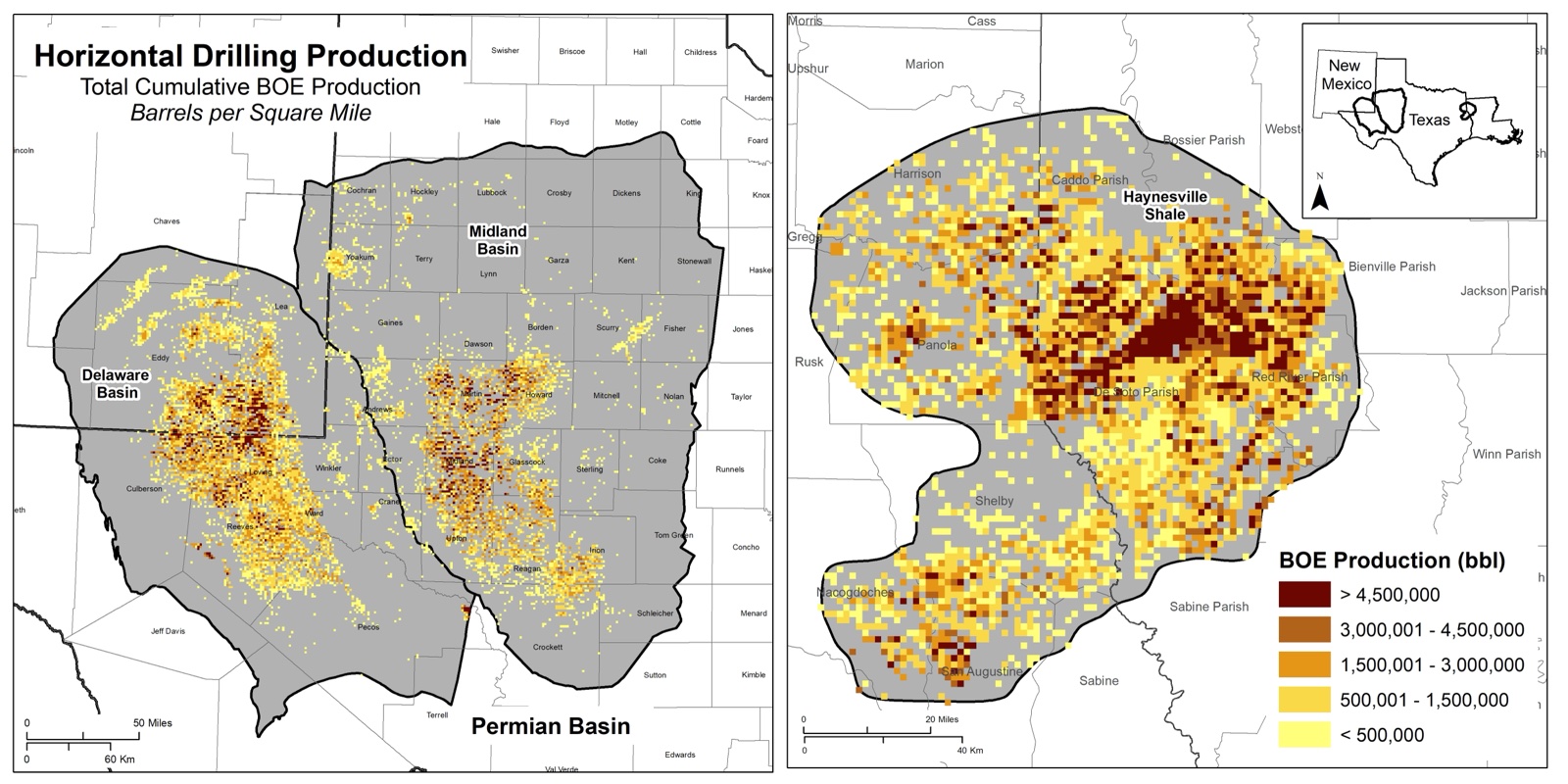
Total cumulative oil and gas production (barrels of oil equivalent per square mile) for horizontal wells in the Delaware and Midland basins and the Haynesville Shale.
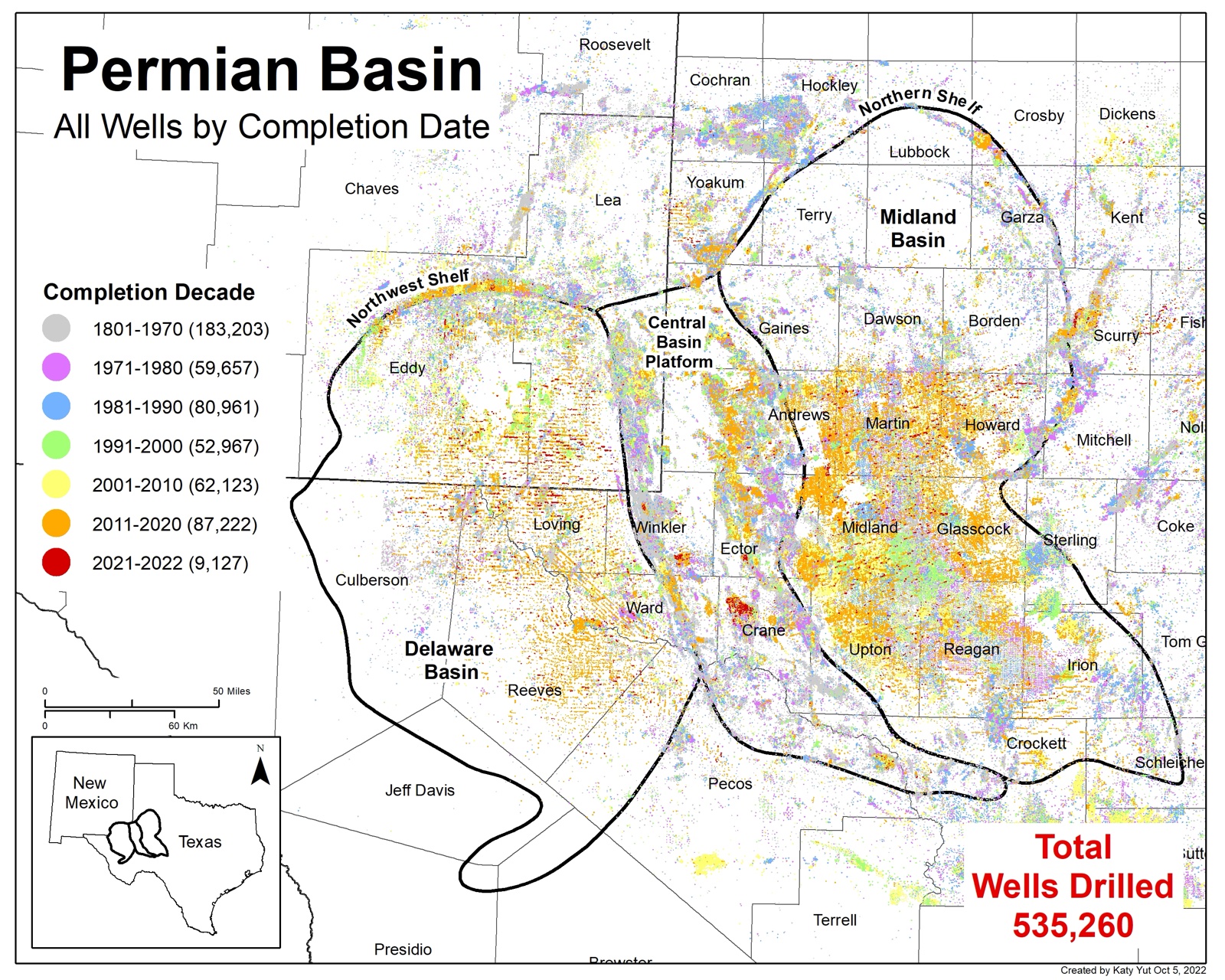
All 535,260 wells drilled in the Permian Basin region, colored by decade completed, from before 1970 through 2022.
The maps supported research published as papers, posters, and presentations, including:
- Smye, K. M., Yut, K., Reedy, R. C., Scanlon, B. R., Nicot, J. P., Hennings, P. (2024). Challenges with managing unconventional water production and disposal in the Permian Basin. AAPG Bulletin 108 (12), 2215–2240. doi:10.1306/08082424025
- Peng, S., Maraggi, L. M. R., Bhattacharya, S., Yut, K., McMahon, T., Haddad, M. (2023). Feasibility of CO2 storage in depleted unconventional oil and gas reservoirs. URTeC.